Sheyola Script Font for Handmade Branding & Printables
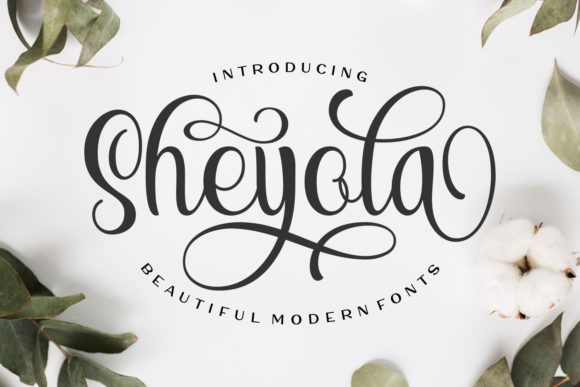
There’s that quiet moment—early morning light, coffee steaming, and your design software open—when you’re choosing the perfect font for a new batch of lavender-scented candle labels. You need something elegant but approachable, refined but warm, timeless but unmistakably *yours*. That’s when Sheyola arrives—not as just another script font, but as a tactile, expressive extension of your handmade voice. Sheyola is a gorgeous looking and chic script font, designed with intention for creators who care how their words feel before they’re even read.
Sheyola for Wedding Invitations and Elegant Branding
When I laid out my first set of wedding invitation suites last spring—cream cardstock, gold foil accents, hand-tied twine—I knew the script had to carry both romance and restraint. Sheyola delivered exactly that: delicate entry strokes, confident exit swashes, and subtle contrast in stroke weight that reads beautifully at 24pt on an RSVP card or 72pt on a welcome sign. Because Sheyola is PUA encoded, accessing alternate glyphs and flourished capitals was seamless—I swapped “M” for a swash version mid-sentence without hunting through character maps. For invitations, Sheyola works best for names, titles, and short decorative phrases—not body copy—but that’s where its strength lies: turning “Emma & James” into something quietly unforgettable.
Sheyola for Candle Labels and Product Packaging Design
Script handwritten fonts can make or break a candle label—too fussy, and it reads like cursive homework; too plain, and it vanishes beside competitors’ bold sans serifs. Sheyola strikes the balance: soft curves, generous x-height, and open counters that stay legible even when scaled down to 10pt on a 2” round sticker. I tested it on matte kraft labels for soy wax candles (“Sage & Sea Mist”, “Honeyed Vanilla”), pairing Sheyola with a clean, low-contrast sans serif (like Montserrat Light) for ingredients and burn instructions. The result? A cohesive, premium look—no extra design time, no licensing guesswork. As a commercial font, Sheyola includes full OTF/TTF files with standard and extended Latin support, so your boutique tags and seasonal packaging stay consistent across Etsy listings, printed hang tags, and Instagram story previews.
Sheyola for Printable Wall Art and Digital Download Templates
If you create digital printables—planner pages, quote posters, nursery art—you know how much weight a single typeface carries in perceived value. Sheyola elevates simple phrases instantly: “Breathe In, Breathe Out” becomes meditative; “Little One” feels tender and intentional. Because it’s a PUA encoded script font, all swashes, ligatures, and stylistic alternates are one click away in Canva, Adobe Illustrator, or Cricut Design Space—no need to install multiple files or memorize alt-code shortcuts. I used Sheyola in a set of minimalist botanical wall art prints, layering it over soft watercolor textures. At 300 DPI and 16x20”, every curve held clarity—even the fine hairlines in the lowercase “g” and “y”. Just remember: for small-format stickers or iron-on transfers, stick to uppercase or bolded swash variants for maximum cut accuracy and readability.
Sheyola for Greeting Cards and Handmade Stationery
Greeting cards live or die by emotional resonance—and Sheyola’s warmth lands every time. Its rhythm mimics natural handwriting without sacrificing polish: slight irregularity in baseline, gentle tapering on terminals, and a graceful forward lean that suggests movement and sincerity. I used Sheyola for a birthday card series featuring pressed florals and linen-textured backgrounds. For “Happy Birthday”, I activated the contextual swash on “H” and “Y”; for “With Love”, I chose the connected “W-i-t-h” ligature. The effect? Instant personality—no extra illustrations needed. When paired with a quiet serif like Playfair Display for the inside message, Sheyola becomes the visual handshake that invites connection before the first word is read.
Sheyola for Tote Bags, Mugs, and Merchandise Design
Applying Sheyola to physical merchandise taught me something practical: this script handwritten font shines brightest when given room to breathe. On a canvas tote bag, I kept it to three words max—“Made With Joy”—centered, at 80pt, with generous letter spacing. On ceramic mugs, I used the bolder swash variant for the handle-side accent (“Hello, Sunshine”) and backed it with a muted sage glaze. Because Sheyola renders cleanly at high resolution and supports OpenType features, it scales predictably from SVG cut files (for vinyl decals) to screen-printed runs. Always test your file in outline mode before sending to production—especially if using swashes near edges—to avoid unexpected clipping or thin-line breaks.
Sheyola for Seasonal Craft Designs and Holiday Tags
Seasonal products demand fonts that feel both fresh and familiar—and Sheyola delivers nostalgic charm without leaning into cliché. Last December, I designed a set of holiday gift tags using Sheyola for names (“For Maya”, “To Grandpa”) and a crisp geometric sans for dates and notes. The contrast felt modern yet heartfelt. Its PUA encoding meant I could quickly cycle through alternate “O”s and “S”s to avoid repetition across dozens of tags—no copy-paste fatigue, no visual monotony. Whether for Easter egg labels, summer picnic napkin prints, or autumn market banners, Sheyola adapts gracefully because its elegance isn’t loud—it’s considered, calm, and deeply human.
Pairing Sheyola with Complementary Fonts for Balanced Layouts
Sheyola thrives in contrast. Try it with:
- A neutral sans serif (like Inter or Lato) for pricing, care instructions, or contact details
- A gentle serif (like Cormorant Garamond) for longer text blocks in invitations or booklets
- A second script font—only if it’s significantly lighter or more structured—for layered hierarchy (e.g., Sheyola for names, Pacifico for subheadings)
Avoid pairing Sheyola with other heavy swash scripts or ultra-thin handwritten fonts—they compete instead of complement. And always check your final file exports: some platforms flatten OpenType features unless you outline text or enable advanced typography settings.
Using Sheyola Responsibly Across Commercial Projects
As a licensed commercial font, Sheyola grants full rights for physical product use, digital templates, and resale of derivative designs—no attribution required. But always verify your license covers your intended use: Cricut Access users should confirm compatibility, and SVG creators must embed or outline Sheyola before distributing cut files. For international audiences, Sheyola supports accented characters common in French, Spanish, and German—ideal for bilingual wedding stationery or EU-based shop branding.